
"Helping woodworkers online for over 20 years"
Wrenches
Though wrenches are not classified as woodworking tools they are used in assembly of projects and to make adjustments to tools and jigs. There are several standards for bolt and nut sizes, SAE (North America), Metric (Asia and most of Europe) and Whitworth (Great Britian) are the three that you will likely encounter. With the increasing global market metric fasteners are becoming much more common in North America.
|
|
Adjustable Wrench
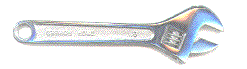
Often referred to as a "Crescent Wrench", "one size fits all" pretty well describes this tool, the bottom jaw moves, by turning a knurl, to fit the nut. They are available in miniature sizes for key rings up to 24" long for heavy duty machinery. An 8 inch is a good size to have in your tool box. When using an adjustable wrench the movable jaw should always face the direction of rotation. The original Crescent Wrench was patented in 1915.
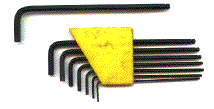
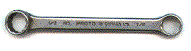
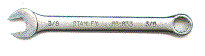
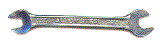
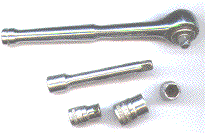
Hex Wrench These are hexagon shaped wrenches, commonly refered to as" Allen Wrenches", bent a right angle that fit into socket head bolts or set screws, some sets now come with a ball on the long end that will allow the wrench to be used at an angle. Most pulleys have an allen set screw attaching them to the motor shafft. The method for manufacturing socket head bolts and set screws was invented by W.C. Allen around 1910. Box End The box on this wrench completely surrounds the nut, they usually have twelve points so the wrench can be reset after rotating only a partial turn. Each end is a different size so one wrench will fit two sizes of nuts. Combination Wrench This wrench has a box on one end and an open end on the other and has become the most popular type of wrench used by the home mechanic or handyman. Open End Each end of this wrench is open, the ends are angled to work in close quarters. Each end is a different size so one wrench fits two sizes of nuts. Socket Wrench Socket wrenches are usually purchased in sets that include various sized sockets, a rachet handle and extensions. Commond size of drives are 1/4", 3/8" and 1/2", both SAE and Metric sockets will fit on the same drives. Allen head, both SAE and Metric,as well as Phillips head sockets are also available. A ratchet was patented by E.P Justice in 1890. |
 |